
Is My Furnace Too Small for My House?
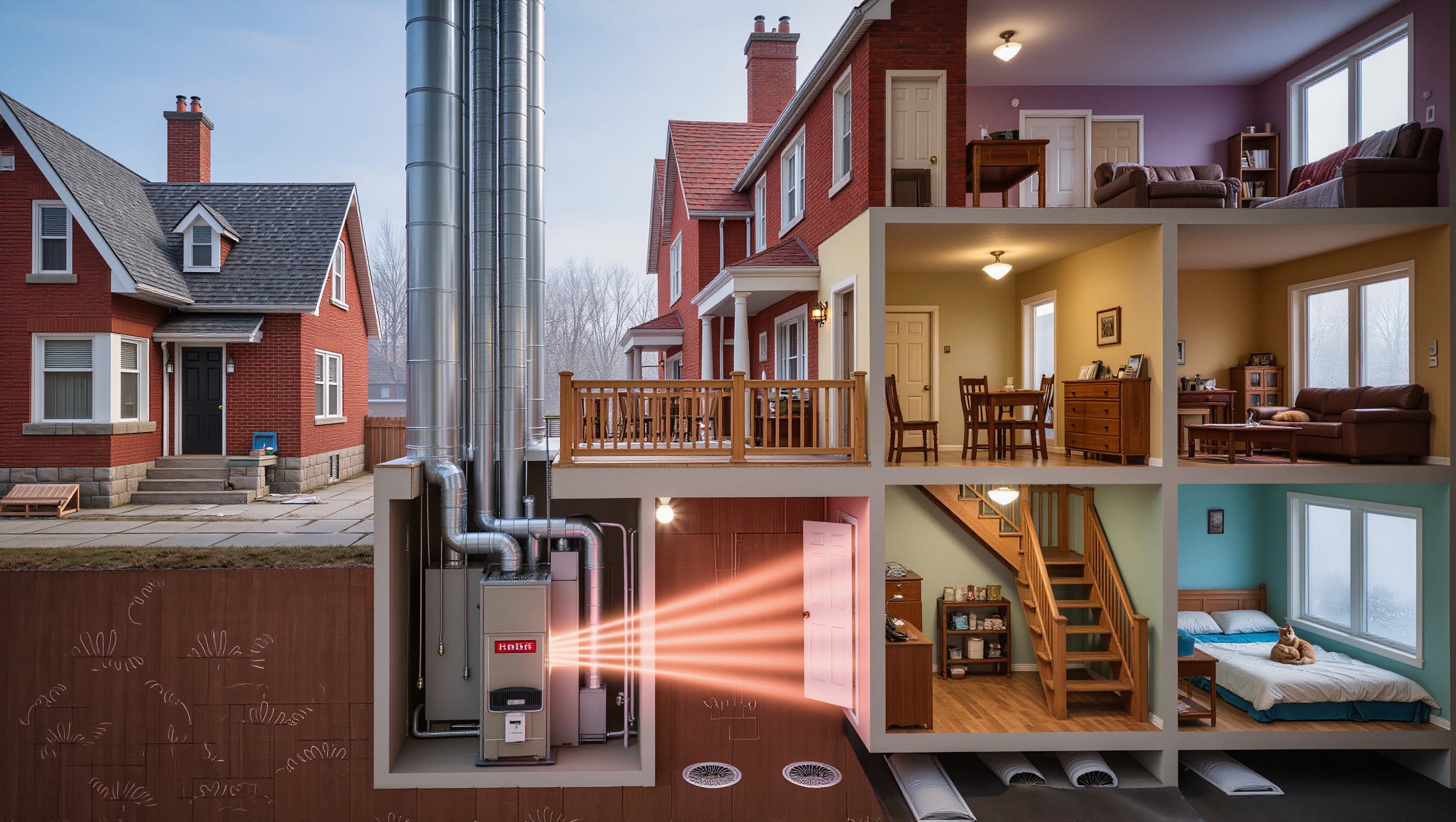
An undersized furnace runs almost nonstop during extreme cold and never quite reaches the target temperature, especially in far-off rooms. The most common cause isn't the unit's age but a poor heat-load calculation at install time, sometimes made worse by a renovation (addition, finished basement) without updating the system. It's not dangerous on its own, but it wears the unit out faster and drives up your bill. Have a professional load calculation confirm the diagnosis before replacing anything.
What's Happening?
A furnace is sized according to a house's heat load, a calculation based on square footage, insulation, windows, and local climate. If the installed furnace is undersized for that load, it has to run at maximum capacity almost continuously to keep up, and still never fully catches up on the coldest days.
The classic symptom: the thermostat is set to 20°C, but the house sits at 17-18°C when it's -25°C outside, and the system barely ever shuts off. Rooms farthest from the furnace or at the end of the ductwork are usually hit hardest.
This problem often shows up after an addition, a finished basement, or large new windows were added without anyone recalculating the house's heating needs.
Is It Dangerous?
No, an undersized furnace isn't dangerous on its own. It doesn't create a fire risk or a carbon monoxide risk simply by being too small. It's a comfort and efficiency issue, not a safety one.
That said, a unit running at full capacity nonstop wears out faster than a properly sized one that cycles normally. Check or have it checked immediately if:
- You smell a persistent burning odor (not just at the first startup of the season)
- The furnace makes new noises (banging, loud whistling)
- Your carbon monoxide detector goes off
Most Common Causes
| Cause | Explanation |
|---|---|
| Poor heat-load calculation at install | Many installers use a rule-of-thumb (square footage) instead of a real load calculation, often underestimating the actual need |
| Addition or finished basement without an update | Heated square footage grows but nobody recalculates the capacity needed |
| Insulation or windows upgraded afterward | Ironically, better insulation elsewhere can reveal that the system was already borderline |
| Undersized or obstructed ductwork | Even a properly sized furnace can seem "too small" if air doesn't reach far rooms well |
| Dirty filter reducing airflow | A dirty filter forces the furnace to work harder for the same result, mimicking undersizing symptoms |
| Insufficient attic or basement insulation | The house loses heat faster than the furnace can produce it |
Why This Happens in Quebec
Quebec has winters with extreme temperature swings: a furnace that's plenty at -10°C can turn out clearly undersized at -25°C or -30°C, which happens several times most winters in much of the province. Many load calculations are done for too mild a design temperature, leaving the house vulnerable during cold snaps.
Older housing stock (postwar bungalows, Montreal triplexes) adds another layer: original insulation is often below current standards, raising the real load without the system ever being resized to match.
How to Check It Yourself
You can spot several clues without touching the unit:
- Note whether the furnace runs nearly continuously (more than 45-50 minutes per hour) on the coldest days
- Compare actual room-by-room temperature with a thermometer, especially rooms far from the furnace
- Check when the filter was last changed — a clogged filter mimics an undersized system
- Note whether the problem started after a renovation or addition
Never try to open the furnace panel, adjust gas settings, or handle the exhaust vent yourself. An accurate heat-load calculation (CSA F280 method) needs to be done by a professional with proper tools and a standardized methodology.
Can I Ignore It?
It depends. If the discomfort is limited to a few degrees on the coldest days of the year, many homeowners choose to live with it until the unit is due for natural replacement. But ignoring it entirely has a cost: the furnace wears its components out faster by running continuously, your gas or electricity bill climbs, and comfort keeps declining if the house keeps evolving (another addition, etc.).
If the temperature gap exceeds 3-4°C on cold days, or some rooms are simply unlivable in January-February, it's worth acting before the next season rather than enduring another winter of it.
How Much Does It Cost?
| Service | Estimated Cost |
|---|---|
| Professional heat-load calculation (CSA F280) | $150 - $350 |
| Optimizing the existing system (ducts, filter, settings) | $200 - $600 |
| Adding a supplemental heat pump | $4,000 - $8,000 |
| Replacing the furnace with a properly sized one | $4,500 - $9,000 |
The load calculation is almost always the right first step — it confirms whether the problem really is sizing, or something else (ducts, insulation) that's much cheaper to fix.
When to Call a Professional
- The house never reaches the set temperature in cold weather, no matter how long the furnace runs
- The gap between rooms consistently exceeds several degrees
- The problem started after a renovation or addition
- You're planning a future addition and want to avoid redoing this diagnosis twice
- Your heating bill jumped significantly without an obvious explanation
A technician can run a real load calculation, inspect the ductwork, and tell you whether the fix is a few hundred dollars or a full replacement.
Related Questions
- Is It Normal for My Furnace to Be 25 Years Old?
- Are There Warning Signs That My Furnace Is About to Fail?
- Why Is It Colder Upstairs Than Downstairs In My House?
- Why Is Just One Room In My House Always Hot?
- My House Feels Cold Even Though the Thermostat Says It's Warm: Why
- My Furnace Smells Like Gas: What to Do Immediately
- Carbon Monoxide and Your Furnace: Warning Signs to Know
- When to Replace Your Heat Pump: 7 Signs to Watch For
Frequently asked questions
Can an undersized furnace actually damage my house?+
No, not directly to the structure itself. The real risk is to the unit, which wears out faster from running continuously, and to your comfort on the coldest days.
Can a smart thermostat fix the problem?+
No. A smart thermostat can optimize cycling but can't produce more heat than a physically undersized unit is capable of. It may help slightly, but it doesn't replace proper sizing.
How much does a professional heat-load calculation cost?+
Expect to pay $150 to $350 for a load calculation done using the CSA F280 method, which accounts for your home's insulation, windows, orientation, and local climate.
Do I need to replace the whole furnace, or can it just be adjusted?+
It depends on the diagnosis. If the issue is ductwork, a filter, or settings, optimization costs $200 to $600. If the furnace is genuinely undersized for the house, replacement is the only lasting fix.
Get a free quote
More to know before your project.
By Marc Tremblay — Certified HVAC technician, 12 years of experience in Quebec
Updated on July 23, 2026