
My Furnace Smells Like Gas: What to Do Immediately
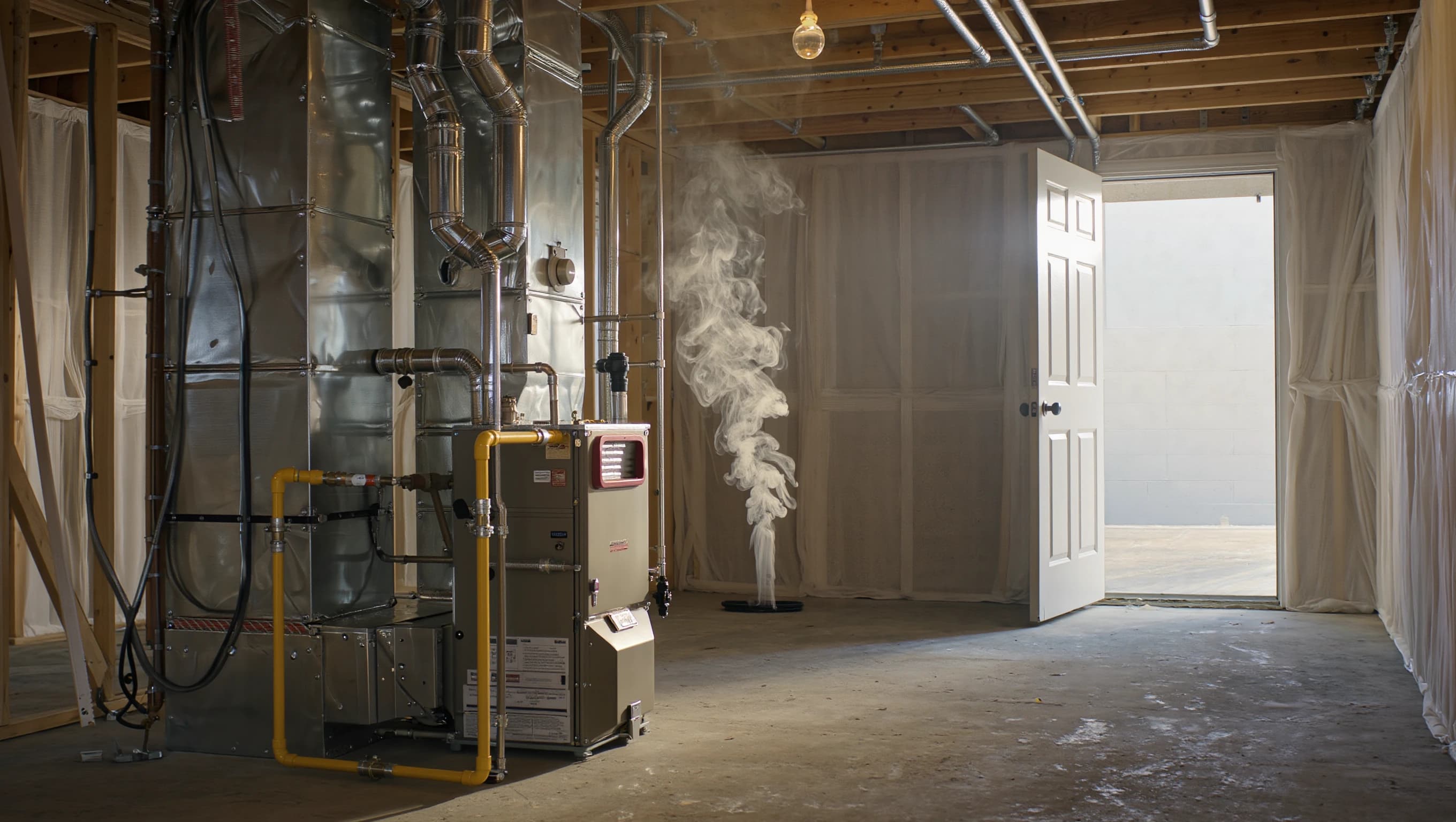
A gas smell near your furnace is potentially dangerous and should always be taken seriously. Get everyone out of the house immediately, don't flip any switches or use a phone inside, and call your gas utility (Énergir at 1-800-361-8003) or 911 from outside. Don't go back in until a professional confirms it's safe. This is never a smell to "keep an eye on" — even if it seems faint.
What's Happening?
Natural gas used in furnaces across Quebec is naturally odorless. Utilities like Énergir deliberately add mercaptan, a compound that smells like sulfur or "rotten eggs," specifically so leaks can be detected by smell before they become dangerous.
If you smell this near your furnace, gas is escaping somewhere in the system — a loose fitting, a faulty valve, a crack in the heat exchanger, or a damaged supply line. Gas building up in an enclosed space like a mechanical room or basement can reach a flammable or explosive concentration.
A faint smell right when the heating season starts (dust burning off components) can be normal and clears within minutes. A persistent or strong smell is never normal.
Is It Dangerous?
Yes, potentially very dangerous. This is one of the rare heating situations that calls for immediate action, not just an eventual inspection.
Leave the house and call immediately if:
- you smell sulfur or rotten eggs anywhere in the house, not just near the furnace
- the smell is strong or getting stronger
- you hear a hissing sound near the furnace or the gas line
- you feel dizzy, have a headache, or feel nauseous at the same time
- you see uplifted dirt or dead vegetation near an outdoor gas line
Do NOT do anything electrical inside the house: no light switches, no phones, no doorbells, no starting a car in an attached garage. A single spark can be enough to ignite accumulated gas.
Most Common Causes
| Cause | Explanation |
|---|---|
| Loose fitting or valve | The pipe connecting the furnace to the main gas line is no longer sealed tight |
| Cracked heat exchanger | A crack in this internal component lets combustion gas escape |
| Faulty pilot light or igniter | Gas builds up without igniting properly at startup |
| Damaged or corroded gas pipe | Physical damage (rodents, corrosion, nearby work) creating a small leak |
| Failing gas valve | The valve controlling gas input no longer closes completely |
| Poor installation or recent repair | A fitting done improperly during recent maintenance or replacement |
Why This Happens in Quebec
A large share of Quebec's housing stock, especially Montreal triplexes and duplexes and postwar bungalows, still runs natural gas furnaces connected to Énergir with piping that can be decades old. Aging joints and fittings, combined with freeze-thaw cycles that shift foundations, raise the risk of leaks over time.
Work on a gas line or appliance is strictly regulated: only a technician holding an RBQ gas license may legally do this work. Never let a handyman or unqualified contractor touch a gas furnace.
How to Check It Yourself
Before leaving, if it's safe to do quickly, you can:
- carefully sniff near the furnace and along visible pipes, without lingering
- check whether a family member left a stove burner on unlit (a common, harmless cause to rule out first)
Never attempt to: search for the leak yourself by touching fittings or the gas valve, use a lighter or match to "locate" the leak, open the furnace panel, or stay in the house to investigate further. Leave that entirely to Énergir or a certified technician with a gas detector.
Can I Ignore It?
No, never. A gas leak doesn't resolve itself and the risk grows with time: gas keeps accumulating in an enclosed space, the risk of explosion increases with any ignition source, and there's a risk of poisoning if the leak involves poor combustion. There is no scenario where waiting is the right call.
How Much Does It Cost?
| Service | Estimated Price |
|---|---|
| Énergir emergency response (detection & shutoff) | Free |
| Inspection and diagnosis by a gas technician | $150 - $300 |
| Fitting or valve repair | $200 - $500 |
| Heat exchanger replacement | $800 - $1,800 |
| Full furnace replacement | $3,000 - $7,000 |
Énergir's emergency visit to detect and secure a leak is free — it's part of their public safety mandate. Charges only apply to the follow-up repair, usually done by an RBQ-licensed heating technician.
When to Call a Professional
- immediately if you smell gas anywhere in the house — call Énergir at 1-800-361-8003 or 911 from outside
- even after Énergir's visit, have the source repaired by a certified technician before restarting the furnace
- if the smell returns after a recent repair
- if you have any doubt, even a slight one — gas technicians would far rather respond to a false alarm than an explosion
Related Questions
Frequently asked questions
Can I keep using my furnace if the smell is very faint?+
No. Even a faint gas smell means there's a leak somewhere. Leave the house and call your gas utility immediately — don't wait to see if it gets worse.
Is it normal to smell gas faintly at the very start of the heating season?+
A faint dusty or "burning" smell on the very first startup can be normal and fades within minutes. A sulfur or rotten-egg smell is never normal, even faintly.
How much does it cost if I call the gas utility about a gas smell?+
Nothing. Detecting and securing a gas leak is part of Énergir's public safety mandate and is always free. Only the follow-up repair, done by a heating technician, is billed.
Should I call a professional immediately if I smell gas?+
Yes, always and without delay. Leave the house first, then call your gas utility or 911 from outside. Never go back inside to "check" before help arrives.
Can a gas leak cause carbon monoxide poisoning?+
They're two distinct but related risks: an unburned gas leak smells like sulfur, while incomplete combustion produces odorless carbon monoxide. A gas furnace problem can cause both — which is why a CO detector matters alongside your sense of smell.
Get a free quote
More to know before your project.
By Marc Tremblay — Certified HVAC technician, 12 years of experience in Quebec
Updated on July 23, 2026