
Why Is Just One Room In My House Always Hot?
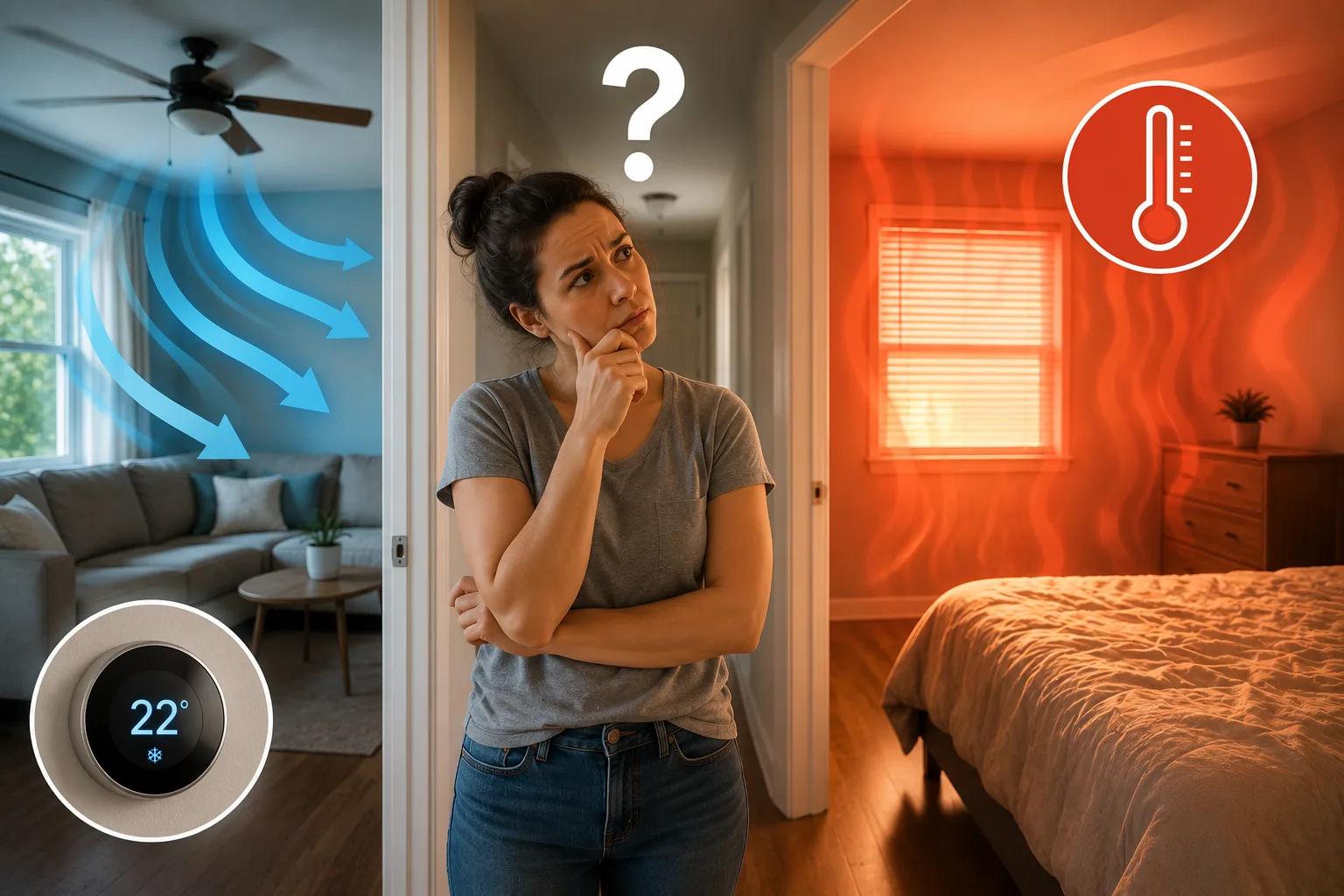
It's almost never dangerous if just one room stays hotter than the rest of the house. The most common cause is an airflow imbalance (ducts, vents, or distance from the unit) combined with sun exposure or poor insulation. It doesn't necessarily mean your AC or heating system is broken — but if the gap is significant (more than 3-4°C / 5-7°F) and persists year-round, it's worth having the air distribution checked or considering a targeted fix for that room.
What's Happening?
A central system (air conditioning, central heat pump, furnace) distributes conditioned air throughout the house through a network of ducts. That network isn't always perfectly balanced: some rooms get more air than others depending on their distance from the unit, duct length, and the number of bends the air has to travel through.
A hotter room usually signals that it's getting less conditioned air than the rest of the house, or that it's gaining more heat than it's losing — often a combination of both: large south- or west-facing windows, poorly insulated exterior walls, heat-generating electronics, or simply a room at the end of the duct run.
Is It Dangerous?
No, it's not a safety or structural risk. It's a comfort issue and, indirectly, a possible sign of energy inefficiency.
It's only genuinely concerning if the temperature gap is extreme (more than 5-6°C / 9-11°F) and appears suddenly, which could indicate:
- A disconnected or punctured duct in the attic or basement
- A vent completely blocked by debris or insulation
- A blower motor losing power
A mild, constant gap (2-3°C / 3-5°F), especially in a top-floor room or one with lots of windows, is normal in most houses.
Most Common Causes
| Cause | Explanation |
|---|---|
| Distance from the central unit | Rooms farthest from the furnace or heat pump get less airflow |
| Sun exposure (south/west windows) | Direct solar heat gain exceeds what the system can offset |
| Closed or blocked vents | Furniture, curtains, or intentionally closed vents reduce airflow into the room |
| Poorly insulated or leaky ducts | Air loses its coolness or warmth before even reaching the room |
| Insufficient insulation or sealing | Poorly insulated walls, ceiling, or windows let outside heat in |
| Room above a garage or in a finished attic | These spaces often have less insulation and more thermal exposure |
| System undersized for total square footage | The unit can't keep up with every room equally during hot weather |
Why This Happens in Quebec
Many Quebec homes, especially expanded bungalows or attics finished into extra bedrooms, don't have a duct network designed for the current layout — the addition was often built after the fact, with a single duct tapped onto a system already sized for the original square footage. Increasingly hot summers and the large south-facing windows typical of newer builds amplify the effect. In Montreal triplexes, top-floor units also suffer particularly from heat rising through the building.
How to Check It Yourself
You can safely:
- Check that all vents in the room are fully open and not blocked by furniture
- Compare the room's temperature to the rest of the house with a simple thermometer, at different times of day
- Notice whether the gap is worse in the afternoon (sign of sun exposure) or constant all day (sign of airflow distribution)
- Check for light or air passing around that room's windows (sign of poor sealing)
Don't go up into the attic or try to redirect ducts yourself without experience — it's often a poorly lit, poorly insulated space with a real risk of falling through the ceiling.
Can I Ignore It?
Yes, to some extent. It's not a problem that worsens over time the way a leak or a broken part does — it stays essentially a comfort issue. But ignoring it often means compensating by lowering the thermostat for the whole house just for that one room, driving up your electricity bill unnecessarily, or installing an energy-hungry portable AC as a stopgap.
How Much Does It Cost?
| Service | Estimated Price |
|---|---|
| Inspection / airflow assessment | $100 - $250 |
| Register adjustment and duct balancing | $150 - $400 |
| Duct sealing or repair | $300 - $800 |
| Dedicated wall-mounted heat pump for that room | $3,000 - $6,000 |
| Full central heat pump installation (if the current system is undersized) | $4,000 - $12,000 |
When to Call a Professional
- The temperature gap consistently exceeds 4-5°C (7-9°F)
- The problem appeared suddenly rather than gradually
- You suspect a disconnected or damaged duct in the attic or basement
- You've already tried opening every vent with no improvement
- You're considering a permanent fix like a wall-mounted heat pump for that specific room
A technician can measure airflow at each vent, spot duct leaks invisible to the eye, and recommend whether a simple adjustment is enough or whether a targeted solution (mini-split) is more cost-effective long term.
Related Questions
- Why Is It Colder Upstairs Than Downstairs In My House?
- Should I Close the Heating Registers In Rooms I Don't Use?
- Is My Furnace Too Small for My House?
- Wall-Mounted vs Central Heat Pump: Which One to Choose
- Why Does My Attic Feel Like an Oven In Summer, and Does It Affect the Rest of the House?
- My House Feels Cold Even Though the Thermostat Says It's Warm: Why
- Why Does My Central Heat Pump Take Longer to Cool the House Than It Used To?
- SEER, HSPF, BTU: Understanding HVAC Terminology
Frequently asked questions
Is it normal for an upstairs bedroom to always be hotter?+
Yes, heat naturally rises and upstairs rooms often get less cool air than the ground floor. A 2-3°C (3-5°F) gap is common and not necessarily a sign of a problem.
Will closing vents in other rooms help?+
Not really, and it can actually harm the system by increasing pressure in the ducts. It's better to partially adjust registers than to close them completely.
Is a wall-mounted heat pump for just one room really worth the cost?+
Yes if the problem is chronic and affects a room you use a lot (main bedroom, home office). It's often more cost-effective than redoing the entire duct network.
Should I call a professional right away for this issue?+
No, this is never an emergency. Check the vents and sun exposure yourself first, then call a technician if the gap persists despite your adjustments.
Get a free quote
More to know before your project.
By Marc Tremblay — Certified HVAC technician, 12 years of experience in Quebec
Updated on July 23, 2026