
I Have a Water Stain on My Ceiling But No Visible Leak on the Roof — Where's It Coming From?
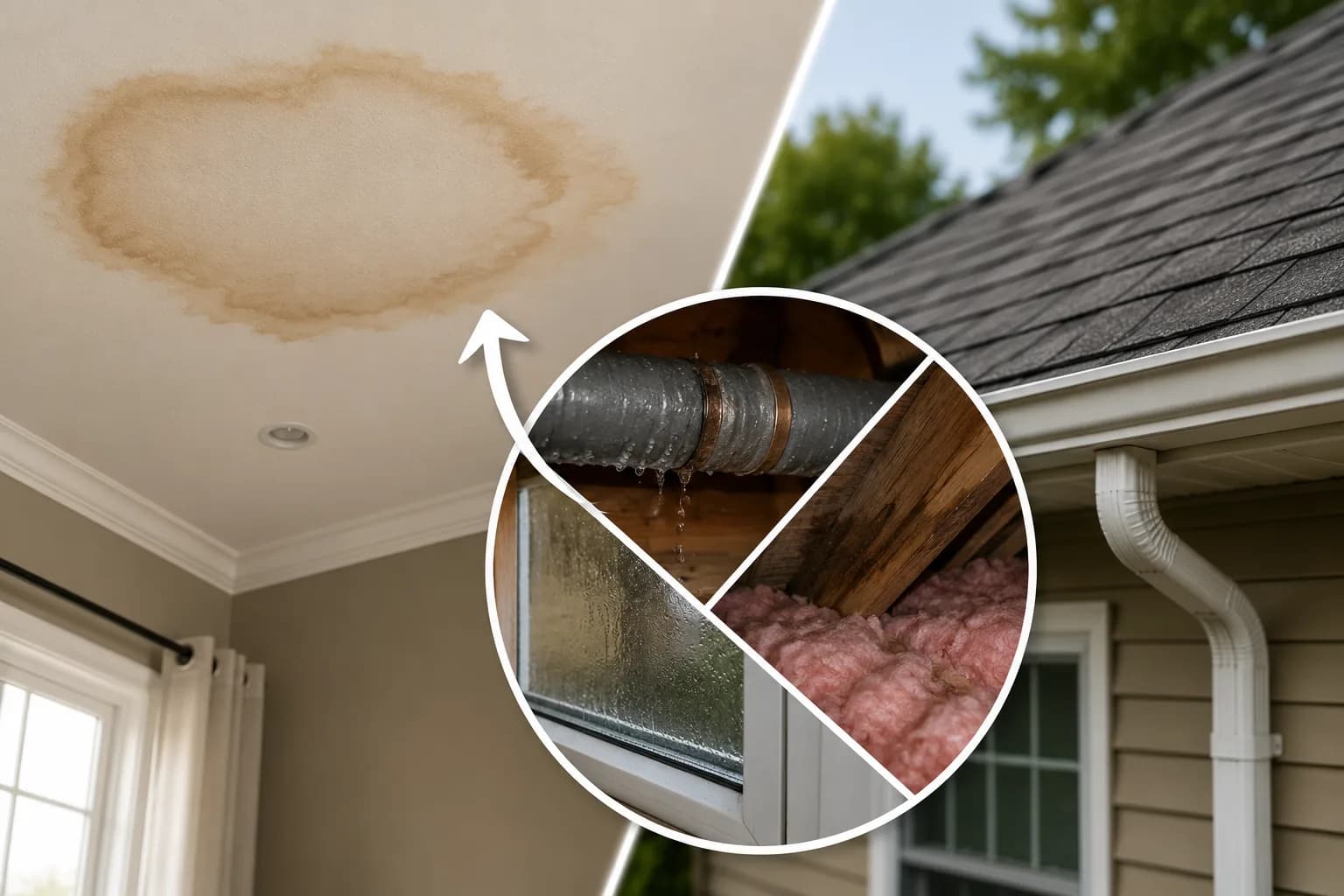
A ceiling stain with no obvious hole in the roof almost never comes from an obvious entry point overhead: water often travels along the rafters or roof sheathing before dripping down, so the real entry point can be several feet from the stain itself. The most common causes are a failed flashing, an ice dam in winter, or a leak around a chimney or roof vent. It isn't always an emergency, but it shouldn't be ignored either — trapped moisture rots wood and encourages mold over time. Have a roofer track down the source before the next heavy rain or fast snowmelt.
What's Happening?
When you look at the roof from the ground or even from a ladder, you're looking for a hole or missing shingle directly above the stain. But once water gets past the roofing material, it doesn't always fall straight down. It often follows the slope along the sheathing, runs along a rafter, then pools at a lower point where the insulation or drywall absorbs enough moisture to leave a visible mark.
That's why a roofer never relies on the stain's location alone to find the leak. They trace the slope upward from the lowest point of the stain, checking every flashing and penetration — chimney, plumbing vent, bathroom fan exhaust — along the way.
A stain that only appears after heavy rain or a fast thaw points to an active leak. A stain that stays the same size over time might also be an old, already-repaired water event — but only an inspection can confirm the source is truly sealed.
Is It Dangerous?
An isolated, dry stain usually isn't an emergency, but an active leak that keeps going can damage the structure and lead to hidden mold.
Inspect or act quickly if you notice:
- The stain is visibly growing week to week
- The drywall feels soft, bulging, or sags to the touch
- A musty smell develops in the room
- Water is actively dripping or running down a wall
- The stain appears right below the attic near a chimney or skylight
If you see active dripping or the ceiling shows signs of sagging, stay out from underneath it and call a professional promptly — a water-saturated ceiling can collapse.
Most Common Causes
| Cause | Explanation |
|---|---|
| Failed flashing (chimney, vent, wall) | The metal sealing roof joints corrodes, lifts, or cracks over time, letting water in at one precise spot far from the visible stain |
| Winter ice dam | Snow melts near the ridge, refreezes at the eaves, forms a dam, and water backs up under the shingles |
| Worn or lifted shingles | Wind or age lifts shingles in spots, creating a leak that isn't visible from the ground |
| Poorly sealed roof vent or chimney flashing | The sealant around penetrations dries out and cracks with freeze-thaw cycles |
| Attic condensation | A poorly ventilated attic traps moisture that drips from the underside of the roof, mimicking a leak |
| Clogged gutter or edge flashing | Water backs up instead of draining and seeps under the first rows of shingles |
| Old unresolved leak | An earlier incomplete repair still lets a little water through on every rainfall |
Why This Happens in Quebec
Quebec's repeated winter freeze-thaw cycles are the number one cause of ice dams, which force water to back up under shingles instead of draining normally. This especially affects poorly insulated or poorly ventilated roofs, where heat escaping from the house melts snow from below.
Older housing stock — postwar bungalows, Montreal duplexes and triplexes — often has original flashing or decades of patchwork repairs, which multiplies the potential weak points. An RBQ-licensed contractor knows where to look first based on the roof's age and type.
How to Check It Yourself
You can safely go up into the attic with a flashlight (if the access is safe and doesn't require an outdoor ladder) and look for moisture marks on the sheathing, stained insulation, or dark-colored wood. Sniff for a musty smell too.
From the ground or an upstairs window, check the flashing around the chimney and vents with binoculars: look for lifted or rusted metal, or cracked sealant.
Never climb onto the roof yourself, especially with ice, snow, or a steep slope present, and don't handle insulation you suspect is moldy without proper protection. Leave the detailed roof inspection to a roofer.
Can I Ignore It?
No, not indefinitely. A stable, dry stain can wait for a routine inspection, but an active water source left untreated keeps damaging the framing and insulation, and can lead to hidden mold inside the walls. The longer you wait, the more expensive the repair becomes, since the water eventually affects a wider area than the original entry point.
How Much Does It Cost?
| Service | Estimated Price |
|---|---|
| Roof inspection to locate the leak | $150 - $350 |
| Spot flashing or shingle repair | $300 - $900 |
| Ice dam repair / removal | $400 - $1,200 |
| Drywall repair and repaint after water damage | $200 - $600 |
| Roof section replacement | $1,500 - $4,000 |
These amounts stay well below a full roof replacement ($6,000 - $18,000), which is only needed if the entire covering is at the end of its life.
When to Call a Professional
- The stain reappears or grows after every rainfall
- You notice a persistent musty smell in the room
- The attic shows blackened wood or wet insulation
- You find no obvious source after a simple visual inspection
- The house is over 15-20 years old and the flashing has never been redone
An RBQ-licensed roofer can run a controlled water test on the roof to reproduce the leak and confirm the exact location before repairing — a step a homeowner can't safely replicate.
Related Questions
- My Ceiling Is Leaking — Do I Call a Roofer or a Plumber?
- Why Are Giant Icicles Hanging From My Roof?
- Are the Icicles Hanging From My Roof Actually Dangerous?
- My Roof Has Black Streaks — Is That Dangerous or Just Ugly?
- Is It Normal to See Daylight in My Attic?
- How Many Missing Shingles Before It Becomes a Serious Problem?
- My Shingles Look Like They're Curling at the Edges: Replace Now or Wait?
Frequently asked questions
Can I just repaint the stain and see what happens?+
Repainting hides the problem but doesn't fix it: if the water source is still active, the stain will come back and the wood underneath keeps deteriorating. Confirm the leak is actually stopped first.
Could it be coming from something other than the roof?+
Yes, especially if the stain is below an upstairs bathroom — it could be a plumbing leak rather than a roof leak. A roofer can confirm whether the source is coming from above or not.
How long does it take for a stain to show up after a leak starts?+
It varies: a significant leak can stain the ceiling within hours, while a small, slow seep can take weeks or months to become visible.
Should I call my home insurance company?+
If the damage is limited to a small stain, it's often worth repairing first and checking your deductible before filing a claim, since a claim can affect your future premiums.
Can a smoke or water test locate the leak with certainty?+
A controlled water test, done section by section by a roofer, is the most reliable way to reproduce and confirm the exact location of a hard-to-find leak.
Get a free quote
More to know before your project.
By Éric Gagné — RBQ-licensed roofer, roofing and roof snow removal specialist
Updated on July 23, 2026