
Why Do My Lights Flicker When I Use the Microwave or Toaster?
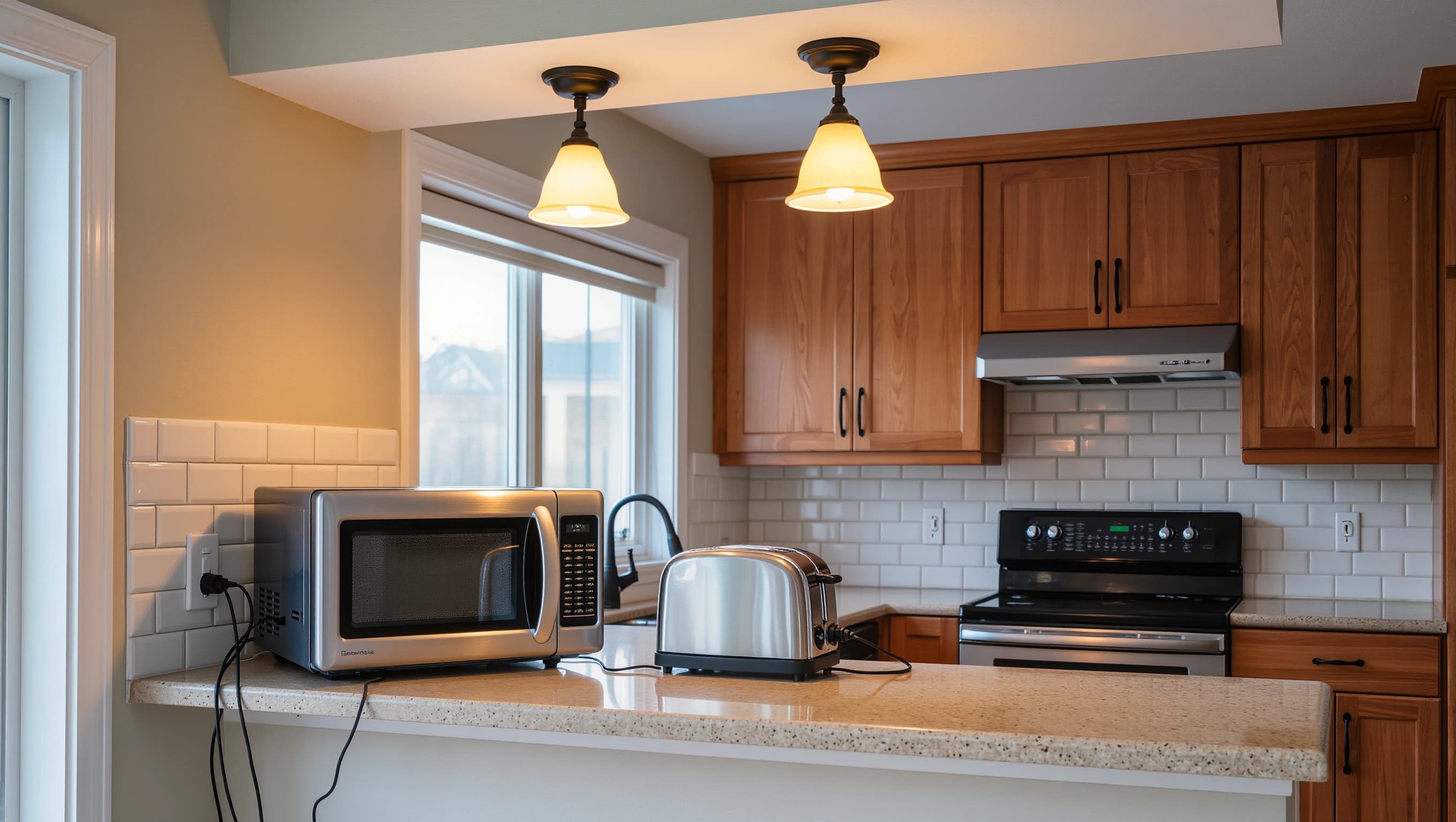
A brief flicker when the microwave or toaster starts up is almost always a normal voltage dip on the shared circuit, not an immediate danger. It's more common with older wiring, an undersized panel, or a loose neutral connection. Don't ignore it if the flickering gets worse, spreads to the whole house, or comes with a burning smell or crackling sound — in that case, call an electrician promptly.
What's Happening?
Microwaves and toasters draw a lot of current all at once when they start, especially the microwave with its transformer. That surge briefly drops the voltage on the circuit, and since lighting is often wired to the same circuit or the same side of the panel, bulbs lose a bit of brightness for a split second.
This is a normal electrical phenomenon called "voltage sag." In a properly sized installation, the dip is too small to notice. If you can clearly see it, that's telling you the circuit or a connection somewhere is weaker than it should be.
LED bulbs often make this more noticeable than old incandescent bulbs, because they react faster to small voltage changes. So if you've recently switched to LEDs, your wiring probably hasn't gotten worse — it's just more visible now.
Is It Dangerous?
In most cases, no. A light, brief flicker limited to the room where the appliance is plugged in is not an electrical emergency. It's annoying, but on its own it's not a sign of fire.
There are situations, though, where flickering deserves a prompt inspection, because it can point to a loose connection that's heating up:
- The flickering shows up in other rooms too, not just the one with the appliance
- You smell burnt plastic or a "hot" smell near the panel or an outlet
- You hear crackling or sizzling at the moment of the flicker
- An outlet or switch plate feels warm or looks discolored
- The flickering has been getting worse week over week
If any of these are present, don't treat it as a minor annoyance — shut off the circuit at the panel and call an electrician.
Most Common Causes
| Cause | Explanation |
|---|---|
| Normal microwave power draw | The transformer or compressor pulls a big current surge at startup, which is normal but noticeable if the circuit is already loaded |
| Overloaded shared circuit | Lighting and kitchen outlets often share the same circuit in older homes |
| Loose neutral connection | A poorly tightened neutral wire in the panel or a junction box causes voltage swings across several circuits |
| Undersized electrical panel | A 60 or 100-amp panel in a modern household struggles to absorb power spikes |
| Loose wires in an outlet or switch | A mechanical connection weakened over time creates resistance that makes voltage fluctuate |
| Long distance between panel and kitchen | A long wiring run increases resistance and makes voltage sag more noticeable |
Why This Happens in Quebec
Many homes and triplexes built before the 1980s in Quebec were wired at a time when kitchens had far fewer electrical appliances than today. A 60 or 100-amp panel, common in this older housing stock, was fine back then but is now marginal with a microwave, dishwasher, fridge, and LED lighting all pulling from the same circuits.
Partial renovations are also common: appliances get upgraded to more powerful models without anyone checking whether the original circuit can keep up. An RBQ-licensed electrician can confirm in a single visit whether your panel and kitchen circuits still match current usage.
How to Check It Yourself
You can safely observe:
- Note whether the flickering stays limited to the appliance's room or spreads elsewhere in the house
- Check the panel to see if the microwave and kitchen lighting are on the same breaker (the panel label should indicate this)
- Sniff, without touching, for any unusual smell near kitchen outlets or the panel
- Note whether the issue started after buying a new appliance or after a renovation
What you should never do yourself: open the electrical panel to tighten connections, remove an outlet or switch from the wall to inspect it while live, or try to move a circuit to a different breaker. These are jobs that require safely cutting power and the expertise only a licensed electrician has.
Can I Ignore It?
It depends. If the flickering is light, limited to the room in question, and has been stable for a long time, you can live with it without immediate risk — many older homes run this way for years.
But if it's getting worse or spreading, ignoring it lets a weak connection keep heating up and degrading with every use cycle. A loose connection that's never tightened can, over time, become a hot spot inside a wall — that's how some residential electrical fires start. The cost of waiting isn't just worse flickering, it's the risk that the underlying problem progresses silently.
How Much Does It Cost?
| Service | Estimated Price (CAD) |
|---|---|
| Electrical diagnostic (visit + testing) | $100 - $200 |
| Tightening connections / repairing an outlet or breaker | $150 - $350 |
| Adding a dedicated kitchen circuit | $400 - $900 |
| Full panel upgrade (if undersized) | $1,500 - $4,000 |
Most flickering cases are resolved with a diagnostic visit and a small repair, well below the cost of a full panel upgrade. An upgrade is only justified if the diagnostic confirms the panel itself is the bottleneck.
When to Call a Professional
- The flickering shows up in multiple rooms, not just the kitchen
- You notice a burnt smell, crackling, or a warm outlet
- The problem has gotten worse over the past few weeks
- You have a fuse panel or one rated below 100 amps
- You're planning to add power-hungry appliances (oven, dishwasher, EV charger)
An electrician can measure the actual voltage under load, check the tightness of every connection at the panel, and confirm whether your setup needs a targeted repair or a broader upgrade — a diagnostic a homeowner can't safely perform themselves.
Related Questions
- My Lights Flicker When the Fridge Turns On: Why & Is It Serious?
- My Breaker Trips Every Time I Use the Microwave and Toaster Together
- My Breaker Trips Every Time I Toast Bread and Make Coffee At the Same Time — Is That Normal?
- Can Old Aluminum Wiring in My House Actually Catch Fire?
- A Warm Electrical Outlet to the Touch: Is It Dangerous?
- Is It Dangerous That My Electrical Panel Still Uses Fuses?
- Why Are My Light Switches Warm to the Touch When the Light's Been On For a While?
Frequently asked questions
Is it normal for flickering to get worse in winter?+
Yes, that's common: in winter more appliances run at once (space heaters, humidifiers, extra lighting), which loads shared circuits more heavily and makes voltage dips more noticeable.
Can I keep using my microwave until the electrician comes?+
If the flickering is mild and there's no odd smell or sound, yes, you can keep using it normally. Stop using it right away if you notice a burning smell, crackling, or a warm outlet.
Can a voltage stabilizer fix the problem?+
A stabilizer can reduce the visible symptom on one specific device, but it doesn't fix the real cause, like a loose connection or an undersized circuit. An electrical diagnostic is still the better first step.
How much does a simple diagnostic visit cost?+
Expect roughly $100 to $200 for a diagnostic visit, which lets the electrician confirm whether a minor repair is enough or the issue runs deeper.
Should I call an electrician immediately?+
Not necessarily urgently if the flickering is mild and localized. But if it spreads to multiple rooms or comes with a burning smell, shut off the circuit at the panel and call right away.
Get a free quote
More to know before your project.
By Isabelle Roy — RBQ-licensed electrician, residential electrical safety specialist
Updated on July 23, 2026