
My Breaker Trips Every Time I Use the Microwave and Toaster Together
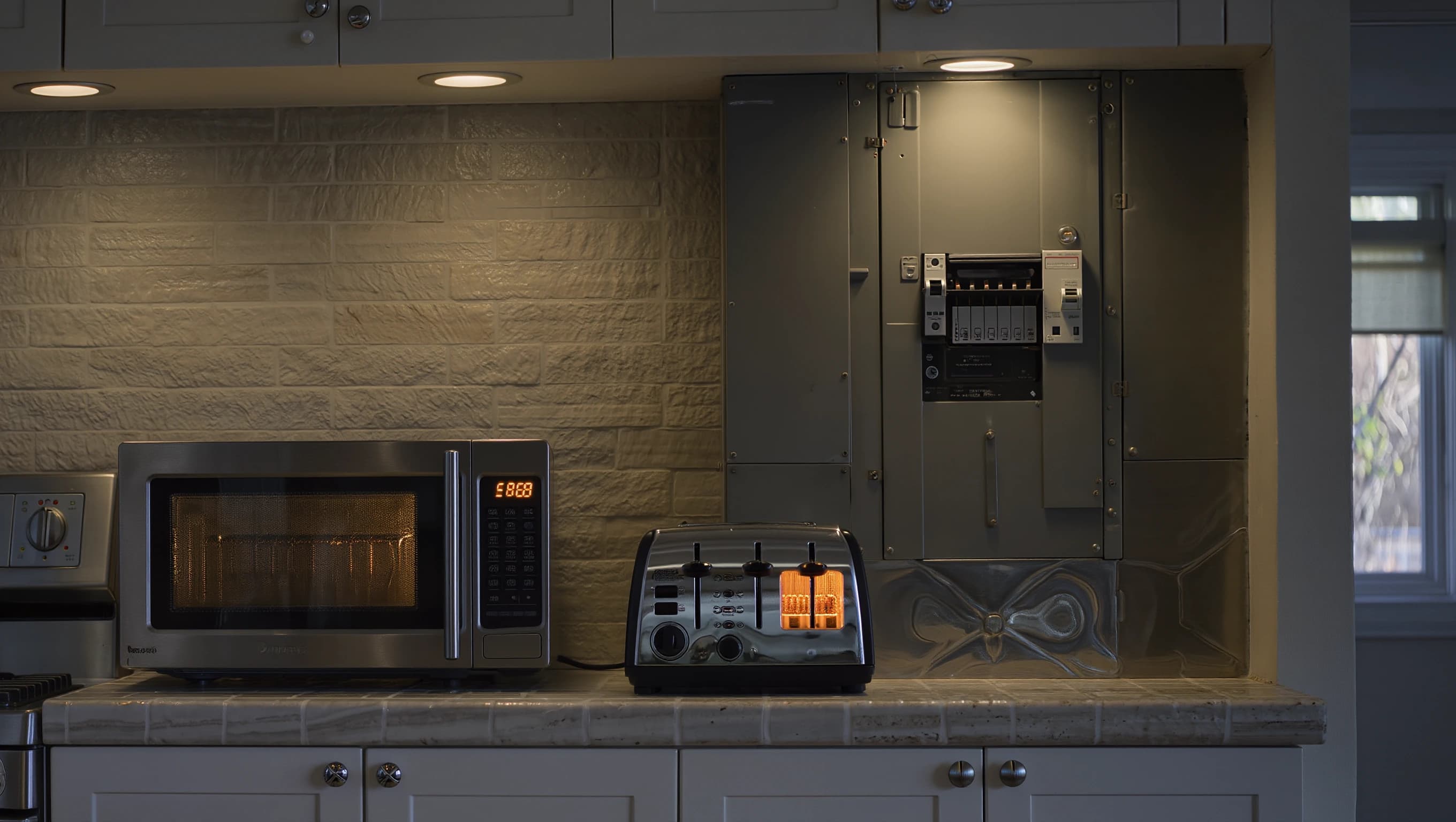
This is almost always normal and not dangerous: the microwave and toaster each draw a lot of current, and together they exceed the capacity of a standard 15-amp kitchen circuit. The breaker is doing exactly its job by cutting power before overheating. It's not an emergency, but if it happens with just one appliance, or the breaker is hot or hard to reset, that's worth having an electrician check.
What's Happening?
A microwave typically draws between 900 and 1,500 watts, and a toaster between 800 and 1,500 watts depending on the model. Together, that can easily exceed 2,000 to 3,000 watts, which demands more than 15 to 20 amps on a standard circuit.
A typical kitchen circuit in a Quebec home is protected by a 15-amp breaker (sometimes 20A), designed to cut power before it exceeds what the wire can safely carry, generally around 1,800 watts continuous for a 15A, 120V circuit.
When you toast bread and heat something in the microwave at the same time on the same outlet or circuit, the combined demand exceeds that limit, and the breaker trips to protect the wire from overheating.
Is It Dangerous?
No, generally not. A breaker tripping in this situation is doing exactly what it's designed to do: protecting your installation from an overload before the wire overheats. It's a safety mechanism working as intended, not a sign of failure.
It becomes concerning if you notice:
- The breaker trips even with just one of the two appliances plugged in
- The breaker is hot or hard to reset
- You smell burning at the panel
- The breaker trips randomly, even with no large appliance running
- The same breaker needs resetting multiple times a day
In those cases, it's no longer a simple matter of normal overload — there may be an issue with the breaker itself or the wiring.
Most Common Causes
| Cause | Explanation |
|---|---|
| Two high-power appliances on the same 15A circuit | Combined demand exceeds the circuit's safe capacity |
| Kitchen with only one dedicated small-appliance circuit | Older kitchens often have just one or two circuits for all counter appliances |
| Other appliances already plugged into the same circuit | A fridge, dishwasher, or coffee maker on the same circuit reduces available headroom |
| Breaker weakened over time | An aging breaker can trip below its original rated capacity |
| Extension cord or power bar used for the appliances | Can create additional voltage drop that worsens the issue |
Why This Happens in Quebec
Many kitchens in Quebec homes built before the 1990s, especially in partially renovated Montreal-area duplexes and triplexes, have only one or two 15A counter circuits, while the current electrical code recommends a minimum of two dedicated 20A circuits for small kitchen appliances.
With appliances gradually added over the decades (microwave, slow cooker, air fryer, coffee machine), the load on these original circuits has increased significantly without the wiring being updated to match.
How to Check It Yourself
You can safely:
- Look inside the panel (without touching the breakers themselves) to see which breaker tripped
- Unplug one of the two appliances, reset the breaker, and test each appliance separately to confirm the combination is the actual issue
- Check for other appliances plugged into the same row of outlets (often fed by the same circuit)
- Note whether the breaker is hard to reset or trips almost immediately, which suggests something other than a simple overload
Never tape a breaker "stuck" in the on position or wedge it with an object, and don't repeatedly reset a breaker if it keeps tripping within seconds — call an electrician instead.
Can I Ignore It?
It depends. If the breaker only trips when you're running both appliances at once, you can simply change your habits (use one at a time) without risk, while you decide whether to invest in a dedicated circuit.
However, if the breaker trips unpredictably or with just one appliance, ignoring the problem can lead to repeatedly resetting a failing breaker, which isn't safe long-term and can mask a real wiring issue.
How Much Does It Cost?
| Service | Estimated Price |
|---|---|
| Panel inspection and diagnosis | $100 - $150 |
| Replacing a faulty breaker | $150 - $300 |
| Adding a dedicated 20A circuit for small appliances | $400 - $900 |
| Adding two dedicated circuits (full kitchen) | $800 - $1,500 |
In most cases where the issue is a simple combined overload, adding a dedicated circuit resolves the situation for good.
When to Call a Professional
- The breaker trips even when only one of the two appliances is used
- The breaker is hot, hard to reset, or trips almost instantly
- You need to reset the same breaker several times a day
- You want to add a dedicated circuit to stop juggling your appliances
- You smell burning or hear an unusual noise at the panel
An electrician can confirm whether the breaker is working correctly, measure the actual circuit load, and evaluate whether adding a dedicated circuit is worthwhile for your usage — an assessment a homeowner can't make with certainty without measuring instruments.
Related Questions
- My Breaker Trips Every Time I Toast Bread and Make Coffee At the Same Time — Is That Normal?
- Why Do My Lights Flicker When I Use the Microwave or Toaster?
- My Lights Flicker When the Fridge Turns On: Why & Is It Serious?
- Is It Dangerous That My Electrical Panel Still Uses Fuses?
- Who Do I Call If My Breaker Trips Every Time My Heat Pump Starts: an Electrician or an HVAC Technician?
- Can Old Aluminum Wiring in My House Actually Catch Fire?
Frequently asked questions
Is it normal for this to happen more often in winter?+
Yes, in winter the kitchen circuit often carries a higher baseline load (kettle, more frequent appliance use), so the overload threshold is reached more easily. It's not dangerous on its own, just a sign the circuit is already well-loaded.
Can I safely reset the breaker myself?+
Yes, resetting a breaker that tripped from a normal overload is safe. Unplug one of the two appliances first before resetting so it doesn't trip again immediately.
How much does it cost to add a dedicated kitchen circuit?+
Generally between $400 and $900 for a single dedicated 20A circuit, depending on the distance between the panel and the kitchen and how accessible the walls are.
Should I call a professional immediately?+
No, not urgently if the breaker only trips when both appliances run together. Instead, schedule a visit if you want to fix the root issue with a dedicated circuit.
Get a free quote
More to know before your project.
By Isabelle Roy — RBQ-licensed electrician, residential electrical safety specialist
Updated on July 23, 2026