
Are Uncovered Electrical Outlets Really Dangerous for My Baby Who's Starting to Crawl?
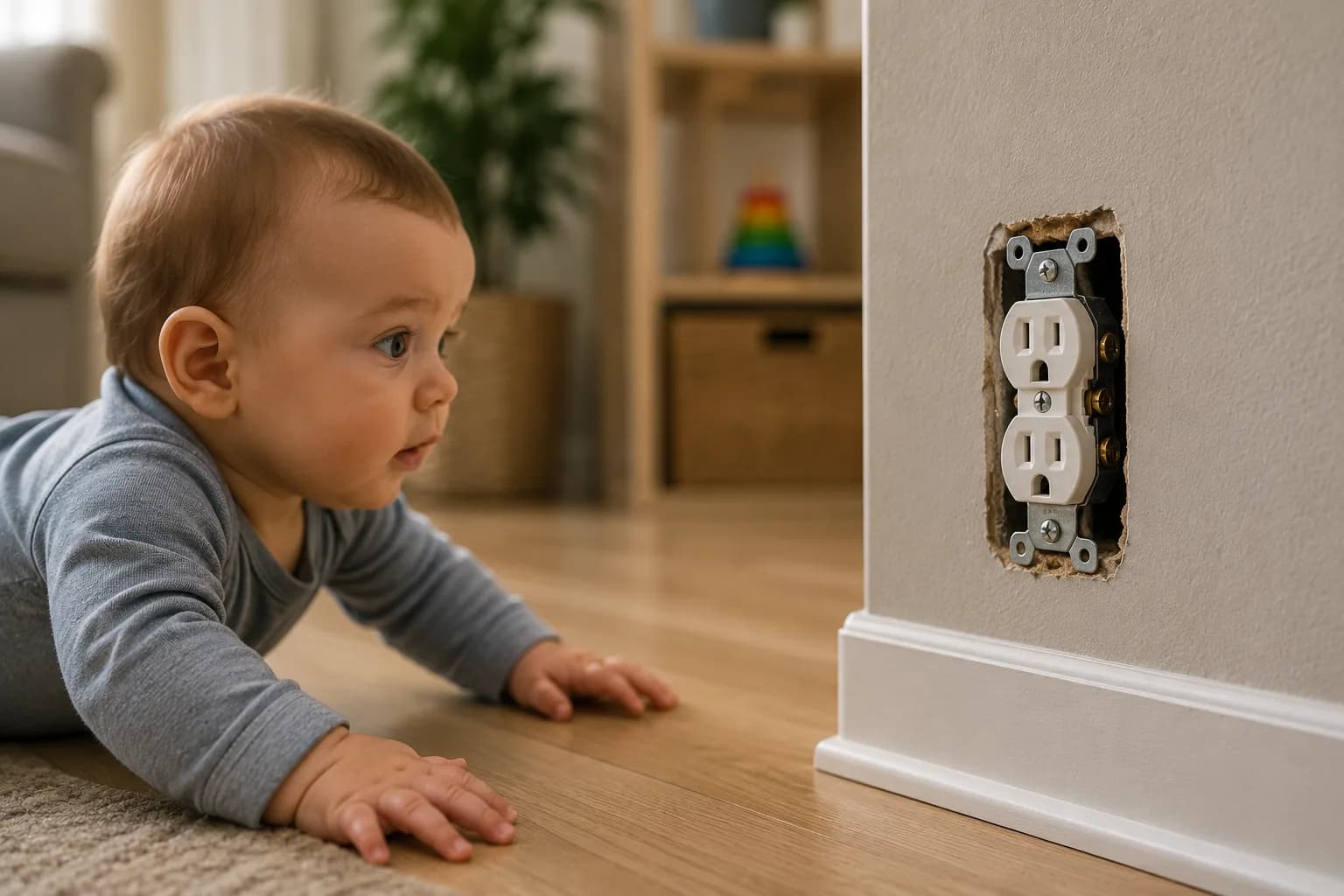
Yes, a standard unprotected outlet is a real risk for a crawling baby: a finger, a key, or a small metal object pushed into the slots can cause an electrical shock or a burn. It's not an emergency if your child isn't crawling yet, but outlets within their reach should be secured before they start moving around, usually between 6 and 10 months. The most reliable fix is replacing outlets with tamper-resistant (TR) models, which are safer than simple plastic covers.
What's Happening?
A standard household outlet has two open slots wired directly to your home's 120-volt current. For an adult, those slots are too narrow and too stiff to insert anything by accident. For a baby exploring the world with their fingers, a key, a bobby pin, or even a metal toy piece can be enough to make contact.
The current passing through the body at that moment can cause an internal burn at the contact point, a shock strong enough to startle and knock the child down, or in rare, more serious cases, a temporary cardiac disturbance. It's precisely because the consequences can be serious — even though the incident itself is brief — that outlets within a baby's reach deserve to be taken seriously.
Is It Dangerous?
Yes, without protection it's a genuine injury risk, not just a theoretical precaution. That said, it's not an electrical emergency requiring a same-night call — it's a risk to eliminate before your baby starts moving around independently.
Check or act quickly if:
- Your baby already crawls or scoots and an outlet within their reach has no protection at all.
- You find plastic covers scattered on the floor (a sign they come out too easily).
- An outlet feels hot, is discolored, or makes a crackling sound — that's a separate, potentially more urgent electrical problem.
- Extension cords or power bars are lying on the floor in a room where the baby plays.
Most Common Causes
| Cause | Explanation |
|---|---|
| Standard non-TR outlets (older home) | Tamper-resistant (TR) outlets have only become a common code requirement in recent years; older homes still have open outlets throughout. |
| Removable plastic covers | Easy for a slightly older baby (12-18 months) to figure out and pull out, so they're not a reliable long-term solution on their own. |
| Low outlets in bedrooms and living rooms | Standard installation height is close to the floor — exactly within a crawling baby's reach. |
| Extension cords and power bars left on the floor | Often overlooked when childproofing a room, just as accessible as a wall outlet. |
| Furniture rearranged | An outlet "hidden" behind a couch becomes accessible again as soon as furniture is moved for the baby's routine. |
Why This Happens in Quebec
A large share of Quebec's housing stock — Montreal triplexes and duplexes, postwar bungalows, country homes renovated piecemeal over the years — was wired long before tamper-resistant outlets became a standard requirement for new construction. As a result, many homes have no built-in protection on any outlet, and everything depends on covers added after the fact, which get lost or fall off over time.
How to Check It Yourself
Get down on all fours in every room your baby spends time in and look at what's at their eye level, the way they would see it. Check that every accessible outlet either has a snugly fitted cover or is a TR model (you can usually tell — the slots look "closed" at rest). Also test that covers don't pop out easily with one hand.
What you should not do yourself: remove an outlet cover plate or touch the wiring inside the wall to "check" anything. If you want to replace outlets with TR models, it's a simple job for an electrician, but it involves cutting power at the right breaker and handling live wires — not a weekend DIY project for a busy parent.
Can I Ignore It?
It depends on your child's age and mobility. If your baby isn't crawling yet, you have time to plan without urgency. But once they start moving, every day without protection is unnecessary exposure — kids explore fast, often faster than parents expect.
Waiting doesn't make the problem worse over time the way a leak or a structural issue would, but the risk stays exactly the same until it's addressed. The right time to secure outlets is before your baby starts crawling, not after a close call.
How Much Does It Cost?
| Fix | Cost |
|---|---|
| Plastic safety covers (whole house) | $10 - $30 |
| Tamper-resistant (TR) outlets, installed by an electrician, per outlet | $40 - $90 |
| Replacing all accessible outlets in a home (10 to 15 outlets) | $600 - $1,500 |
| Electrician visit to assess overall home electrical safety | $100 - $200 |
A larger project like a full electrical panel upgrade runs $1,500 to $4,000 — securing outlets is a fraction of that budget and can often be done in a single visit.
When to Call a Professional
- You want to replace standard outlets with TR outlets in several rooms.
- An outlet feels hot, is discolored, makes noise, or smells odd — that's a separate electrical issue to address first.
- Your panel is old (fuses, or a Federal Pacific or Zinsco panel) and you'd like a full electrical safety assessment before the baby arrives.
- You're renovating a child's room and want outlets added or moved away from the crib or changing table.
Related Questions
- Can the Electric Baseboard Heater In My Baby's Room Cause Burns or a Fire?
- How Do I Know If My Carbon Monoxide Detector Really Protects My Baby's Room?
- A Warm Electrical Outlet to the Touch: Is It Dangerous?
- Can Old Aluminum Wiring in My House Actually Catch Fire?
- Is It Dangerous That My Electrical Panel Still Uses Fuses?
- Why Did One of My Outlets Suddenly Stop Working?
- Why Does My Smoke Detector Chirp Occasionally Even With a Fresh Battery?
Frequently asked questions
Are simple outlet covers enough, or do I really need TR outlets?+
Plastic covers are better than nothing, but a 12-18 month old quickly learns to pull them out. Tamper-resistant (TR) outlets offer permanent protection that doesn't rely on a removable accessory, especially for frequently used outlets.
At what age should I secure my outlets?+
Ideally before your baby starts crawling, often between 6 and 10 months. Many parents wait too long because they underestimate how quickly a child becomes mobile.
Can I install TR outlets myself?+
Technically yes if you're comfortable with basic electrical wiring and cut the correct breaker, but a wiring mistake can create a shock or fire risk. For a baby's safety, most families prefer to leave this job to an electrician.
Are outlets behind furniture still a risk?+
Yes, as soon as furniture is moved, an outlet you thought was "hidden" becomes accessible again. It's best to secure every outlet at a baby's height, not just the ones visible in the current furniture arrangement.
Get a free quote
More to know before your project.
By Isabelle Roy — RBQ-licensed electrician, residential electrical safety specialist
Updated on July 23, 2026