
How Do I Know If My Carbon Monoxide Detector Really Protects My Baby's Room?
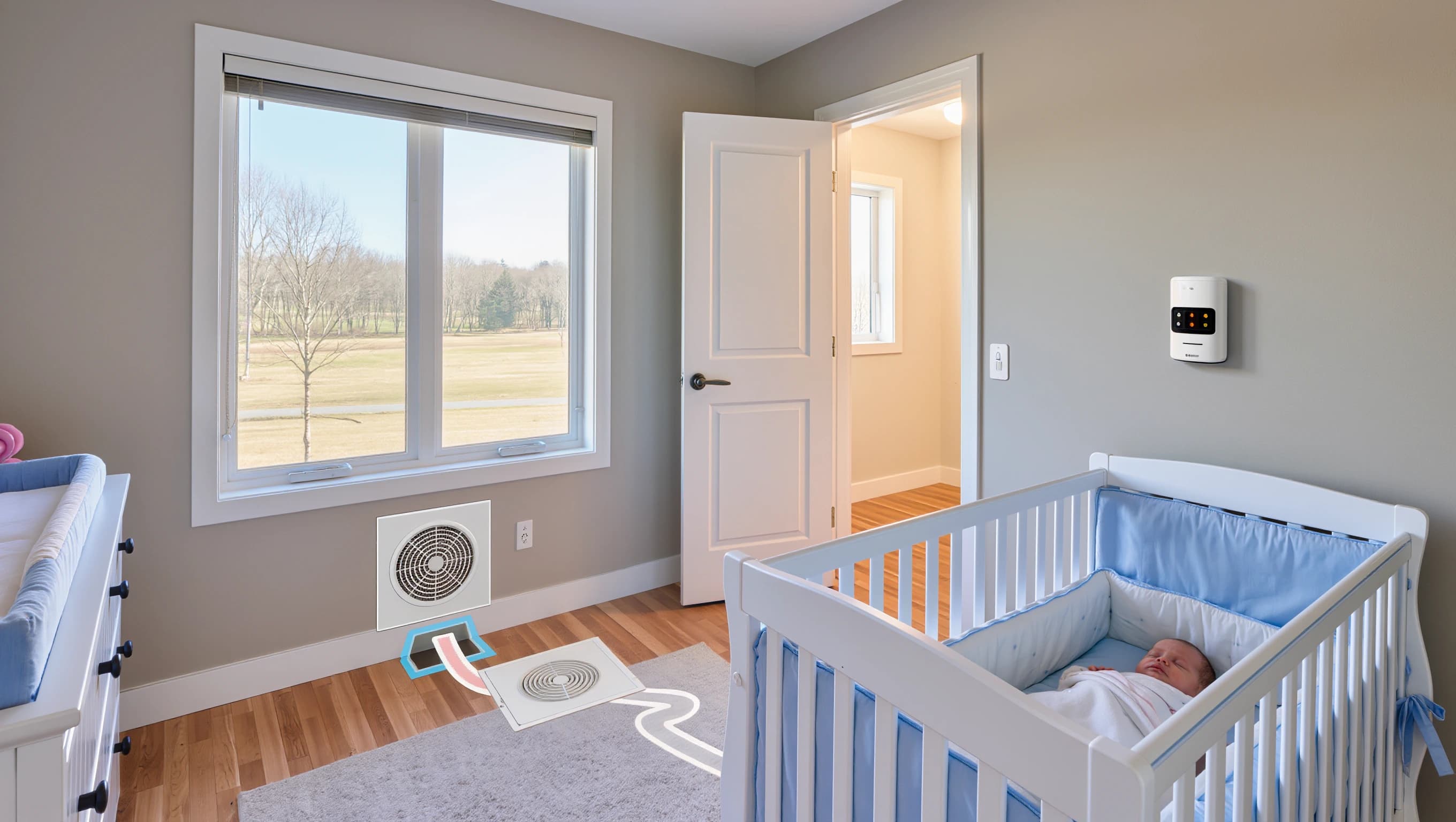
Not necessarily — having a carbon monoxide detector somewhere in the house doesn't guarantee your baby's room is protected. What matters is distance (a detector in the basement may not be heard through a closed door upstairs), the unit's age (a 5 to 10 year lifespan depending on the model), and battery condition. This isn't alarming on its own, but it's worth checking all three today, especially if your home has a gas or wood-burning appliance or an attached garage.
What's Happening?
Carbon monoxide (CO) is an odorless, colorless gas produced by incomplete combustion of natural gas, propane, wood, or gasoline — a faulty furnace, a poorly vented fireplace, a generator, or a car left running in an attached garage are the most common sources at home. Because you can't see or smell it, a detector is the only reliable way to know it's building up.
The problem is that a detector only protects what it can reach. A unit installed in the basement near the furnace may well detect a leak there, but if its alarm is faint and the baby's bedroom door is closed upstairs, the sound may not be loud enough to wake anyone in time.
Is It Dangerous?
Carbon monoxide itself is potentially fatal at high concentrations — which is why asking whether the baby's room is really protected is a legitimate question, not paranoia. But having a poorly placed detector isn't an emergency in itself: it's a coverage gap to fix, not a sign that CO is present right now.
Check or act immediately if:
- Your detector is actively sounding — get everyone out of the house and call 911 before investigating the cause.
- You have no CO detector on the floor where the baby sleeps, and the home has a gas or wood-burning appliance or an attached garage.
- The detector's manufacture date is more than 7 to 10 years old (depending on the model) — its detection ability degrades with age, even if it "seems" to work.
- No one in the house knows where the CO detectors are installed or how old they are.
Most Common Causes
| Cause | Explanation |
|---|---|
| Detector too far from the bedroom | A single unit in the basement or on the main floor may not be heard through a closed door upstairs. |
| Doors closed at night | Block sound transmission and reduce perceived volume, especially with draft strips installed for winter. |
| Expired detector | Most CO detectors have a 5 to 10 year lifespan; past that point, the sensor loses reliability even if the unit "seems" to work. |
| Weak or removed battery | A dead battery left unreplaced, or removed because of an annoying chirp, leaves the unit completely inactive. |
| No detector near an attached garage | A car warming up in a garage attached to the house can push CO into adjacent rooms, including a bedroom above the garage. |
Why This Happens in Quebec
Quebec's building code requires a CO detector near bedrooms in homes with a combustion appliance (gas furnace, fireplace, wood stove) or an attached garage — but this requirement mainly applies to recent construction and renovations. Many older homes have only a single, poorly placed detector, often originally installed near the furnace rather than near the bedrooms. Long winters and homes sealed tight against the cold make the problem worse too: closed windows and constant heating increase exposure time if a leak occurs, and gas or wood heating appliances are especially common outside the major cities.
How to Check It Yourself
Locate every CO detector in the home and note its position relative to the baby's room — ideally there should be one within about 20 feet (6 m) of every bedroom door, or at minimum one on each occupied floor. Check the manufacture date printed on the back of the unit; if it's past the manufacturer's stated lifespan, replace it regardless of whether it "seems" to work. Test each unit's test button with the bedroom door closed to gauge whether the sound is actually audible from the crib.
What you should not do yourself: ignore a sounding alarm assuming it's faulty, or try to "fix" a detector that fails its test button — just replace it. If you suspect an actual CO leak, don't stay in the house to investigate.
Can I Ignore It?
No, not if you discover the baby's room isn't actually covered. This isn't a problem that physically worsens over time the way a water leak would, but the real risk — CO exposure going undetected in time — stays exactly the same until coverage is fixed. It's a simple, inexpensive fix; there's no good reason to put it off.
How Much Does It Cost?
| Fix | Cost |
|---|---|
| Standalone battery-powered CO detector | $25 - $60 |
| Combo smoke + CO detector | $40 - $90 |
| Hardwired interconnected CO detector, installed by an electrician | $100 - $200 per unit |
| Emergency visit if an alarm sounded and the home needs checking | $150 - $500 |
When to Call a Professional
- A CO alarm has sounded, even once for no obvious reason — have a qualified professional check the source before reoccupying the home normally.
- You want hardwired, interconnected detectors (that all sound together) instead of standalone battery units.
- Your home has an attached garage, a gas furnace, or a fireplace, and you're not sure current coverage meets recommended distances.
- You notice symptoms like headaches, nausea, or unusual fatigue that improve when you leave the house — a possible sign of CO exposure even without a triggered alarm.
Related Questions
- Can the Electric Baseboard Heater In My Baby's Room Cause Burns or a Fire?
- Are Uncovered Electrical Outlets Really Dangerous for My Baby Who's Starting to Crawl?
- Why Does My Smoke Detector Chirp Occasionally Even With a Fresh Battery?
- Is It Dangerous That My Electrical Panel Still Uses Fuses?
- Can Old Aluminum Wiring in My House Actually Catch Fire?
Frequently asked questions
How many CO detectors do I need for a two-story home?+
At minimum one per occupied floor, with particular attention to the floor where the bedrooms are. If the home is large or bedrooms are spread apart, one detector per bedroom hallway is safer.
Is it normal for my CO detector to chirp occasionally?+
An isolated chirp every 30 to 60 seconds usually signals a low battery, not CO detection — replace the battery. A loud, continuous alarm signals actual detection and means you should evacuate.
Should I call a professional right away if I find my baby's room isn't covered?+
Not urgently if no alarm has sounded — you can buy and install a standalone battery detector yourself in the meantime. An electrician becomes useful if you want hardwired, interconnected units throughout the house.
Can a smoke detector also detect CO?+
Only if it's a combo smoke and CO model clearly labeled as such. A standard smoke detector only detects smoke and will never react to a carbon monoxide leak.
Get a free quote
More to know before your project.
By Isabelle Roy — RBQ-licensed electrician, residential electrical safety specialist
Updated on July 23, 2026