
My Outdoor Pot Lights Fog Up on the Inside Every Winter: Why?
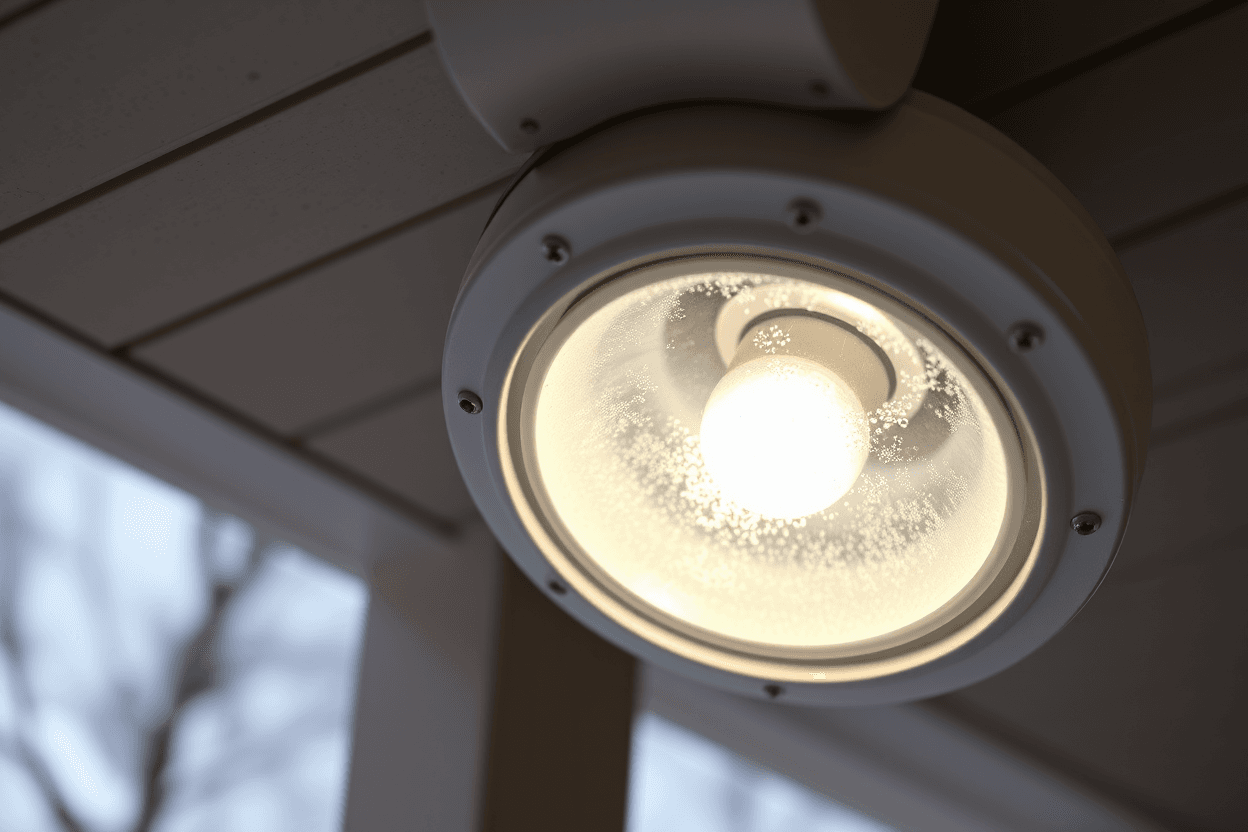
Fog inside an outdoor pot light almost always comes from warm, humid house air leaking into the fixture housing and condensing against the cold glass. It's common in Quebec winters because of the huge indoor-outdoor temperature gap. It's not dangerous right away, but lingering moisture can damage the fixture and eventually create an electrical hazard.
What's Happening?
An outdoor pot light is recessed into the ceiling of a porch, balcony, or overhang. Behind it there's often a space connected to the heated interior of the house: an attic, soffit, or ceiling cavity.
Warm house air holds far more moisture than cold outdoor air. When that humid air leaks into the fixture housing and hits the cold glass or lens, it condenses into fog and sometimes into actual droplets.
It's the same principle as a window fogging up from the inside in winter, just concentrated inside a small sealed enclosure.
Is It Dangerous?
Not immediately. A little fog doesn't cause an instant electrical shock, especially if the fixture is rated for wet locations (IP44 or higher) and properly sealed electrically.
But repeated moisture over several winters can:
- Corrode electrical connections and the bulb socket
- Rust the metal housing
- Cause a short circuit if water reaches the wiring
- Trip the breaker or blacken the socket
If you see actual water dripping (not just fog), if the fixture trips the breaker, or if you smell burning, shut off the breaker immediately and call an electrician.
Most Common Causes
| Cause | Frequency |
|---|---|
| Worn or failed sealant/gasket around the fixture | Very common |
| Warm attic or ceiling air leaking into the housing | Very common |
| Fixture not rated for outdoor use or insufficient IP rating | Common |
| Insufficient insulation around the recessed housing | Common |
| Poor roof or soffit ventilation pushing humid air toward the fixture | Occasional |
| Cracked lens or glass letting in outdoor moisture | Occasional |
| Condensation from high indoor humidity levels | Less common |
Why This Happens in Quebec
Quebec winters create a massive temperature gap between the heated interior and the outdoors, sometimes over 40 degrees Celsius apart in a single day.
That gap pushes humid air toward cold surfaces through a process called vapor drive — the exact same mechanism behind window frost and roof icicles.
Well-insulated homes with poorly sealed electrical boxes are especially prone to this: the insulation traps heat, but if there's a gap or a bad seal around the fixture, humid air finds a direct path into the light.
Quebec's frequent freeze-thaw cycles make it worse too — every cycle stresses sealants and gaskets, which eventually crack.
How to Check It Yourself
- Shut off the breaker for that circuit before inspecting anything.
- Look inside the fixture: is it light fog, visible droplets, or standing water?
- Check the caulking around the fixture at the ceiling — is it cracked, peeling, or missing?
- If accessible, check the attic or space behind the fixture for an obvious gap to the outside.
- Check the fixture's label for an IP44, IP54, or "wet location" rating.
- Note whether fog only shows up in extreme cold or all the time.
Don't turn the fixture back on if you see standing water inside the housing.
Can I Ignore It?
Occasional light fog during extreme cold, with no standing water, can wait for routine maintenance. It's not an emergency.
But don't let it sit too long if:
- Water is visibly pooling at the bottom of the fixture
- The fixture trips the breaker or flickers abnormally
- You see rust or corrosion on the housing
- The bulb burns out much more often than before
Letting this go for several winters raises the risk of permanent electrical damage and a full fixture replacement instead of a simple repair.
How Much Does It Cost?
| Fix | Estimated Cost (CAD) |
|---|---|
| Re-caulking or sealing the fixture | 80$ - 200$ |
| Replacing the internal gasket/seal | 100$ - 250$ |
| Replacing the fixture with a proper outdoor-rated model | 150$ - 400$ |
| Full electrical diagnostic by an electrician | 150$ - 300$ |
| Electrical emergency (short circuit, tripping breaker) | 150$ - 500$ |
| Improving attic insulation/ventilation around the fixture | 300$ - 800$ |
When to Call a Professional
Call an electrician promptly if:
- You see standing water, not just fog
- The fixture trips the breaker, flickers, or makes unusual sounds
- You smell burning or hot plastic
- The housing is visibly rusted or corroded
- You're not sure your fixture is actually rated for outdoor use
An electrician can check the seal, replace the fixture with a proper wet-location model, and rule out any short-circuit risk. If the root cause is attic insulation or ventilation, an insulation contractor may also be needed.
Frequently asked questions
Is it normal to have a little fog in my outdoor lights in winter?+
Occasional light fog during extreme cold is not unusual and isn't necessarily serious. It signals a minor sealing issue. You should act if the fog turns into standing water or if the fixture starts tripping the breaker.
Can I fix the sealant on an outdoor recessed light myself?+
You can re-caulk the exterior perimeter yourself after shutting off the breaker, but the inside of the housing and the wiring should be checked by an electrician, especially if you see water near the connections.
Are all outdoor light fixtures supposed to be waterproof?+
No. Outdoor fixtures should carry an IP44 rating or higher, or be labeled for a wet or damp location. If your fixture has none of these markings, it's likely not designed for outdoor use and should be replaced.
Can fog in my fixtures damage the rest of my electrical system?+
If water reaches the wiring inside the housing, it can cause a localized short circuit, trip the breaker, or damage connections. This usually isn't a risk to your whole electrical panel, but it can require replacing the fixture.
Get a free quote
More to know before your project.
By Isabelle Roy — RBQ-licensed electrician, residential electrical safety specialist
Updated on July 24, 2026