
How Much Does a Heat Pump or a New Roof Actually Add to My Home's Resale Value?
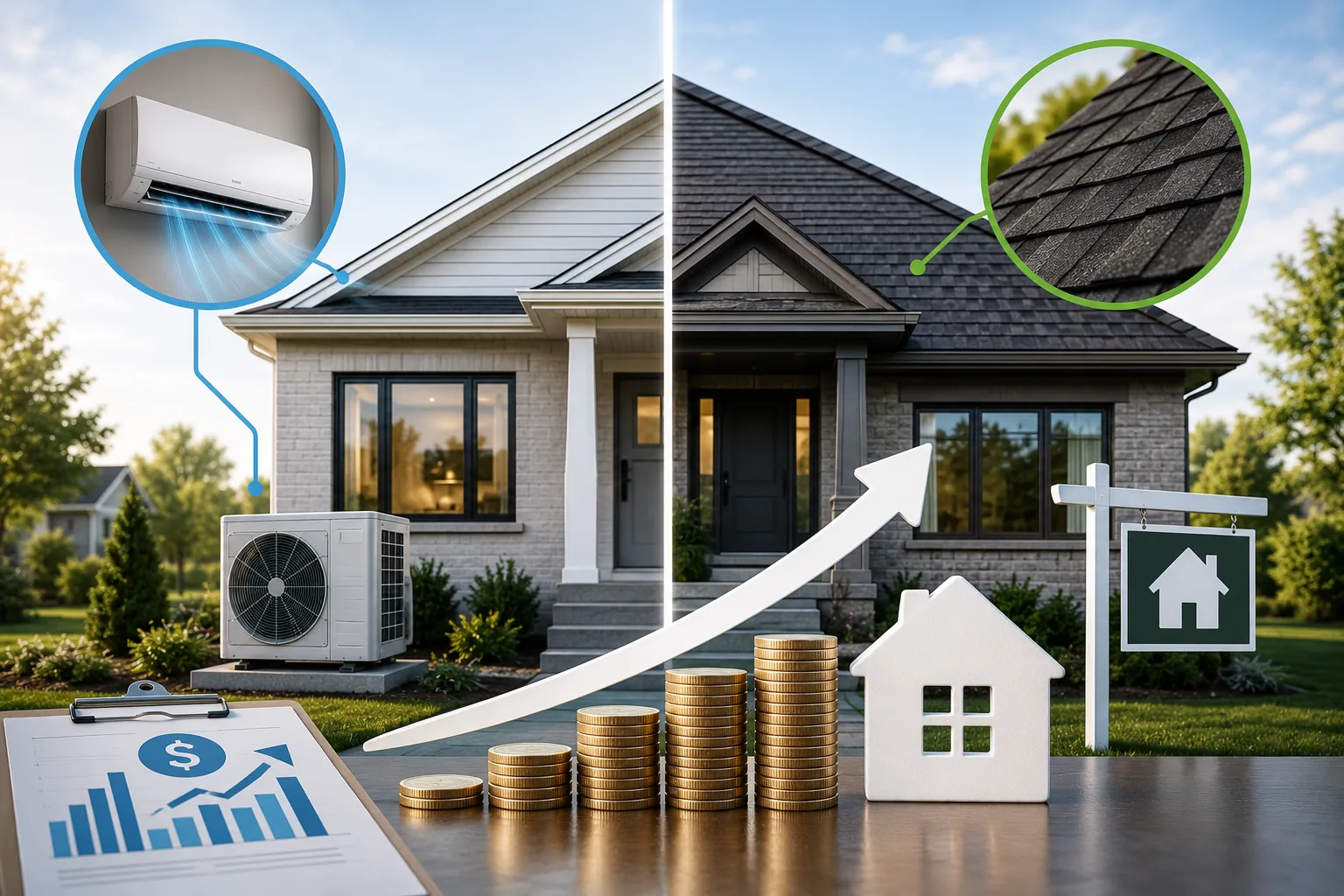
A new roof or a heat pump represents a significant expense, and the argument often used to justify it is that it "pays for itself at resale." The reality of that return on investment deserves more nuance than being taken for granted.
Why these upgrades never "pay back" 100%
A major upgrade like a roof or a heat pump generally raises the home's perceived value, but rarely by an amount equal to the total cost invested. The gap comes from the fact that a buyer pays for the added value and peace of mind, not to directly reimburse the seller's bill.
What influences the actual return on investment
| Factor | Impact on the return |
|---|---|
| The roof or system's condition before replacement | A replacement that avoids an imminent failure carries more perceived value than an early, unnecessary one |
| Local real estate market at the time of sale | A seller's market generally values these upgrades more than a buyer's market |
| Buyer expectations in the area | In some neighborhoods, a heat pump is nearly expected, boosting its impact on perception |
| Available documentation and warranty | A documented installation with a transferable warranty reassures the buyer and better supports the asking price |
Why the absence of these items costs more than their presence adds
The most significant impact of these upgrades is often not the direct value added, but rather the value avoided in negotiation: a visibly aging roof or the absence of cooling in a home where buyers expect it becomes a downward negotiation point, often for an amount exceeding the actual cost of the missing upgrade.
How to assess whether the investment is worth it for your situation
If a replacement is necessary anyway (roof at end of life, failing system), the resale argument becomes secondary — the investment is justified by necessity rather than pure return. If the replacement is discretionary and mainly motivated by future resale, comparing the cost against local market data, available from a real estate agent, gives a more realistic estimate than assuming a full payback.
What to keep in mind before investing purely for resale
An upgrade made mainly for comfort or necessity, with resale benefit as a secondary perk rather than the main motivation, generally remains the soundest approach rather than treating the renovation as a pure financial investment.
Frequently asked questions
What percentage of a new roof's cost is generally recovered at resale?+
It varies enormously by local market and the condition of the replaced roof, with no reliable universal percentage — a local real estate agent gives the best estimate.
Is a heat pump a better resale investment than a roof?+
It mostly depends on each item's current condition and local market expectations — both can have a significant impact depending on context.
Is it worth replacing a still-functional roof just for resale?+
Rarely worthwhile as a purely financial calculation — a functional but aging roof can instead be negotiated with a reasonable discount to the buyer.
Does a transferable warranty really make a difference for a buyer?+
Yes, it reduces the buyer's perceived uncertainty and can support a higher sale price compared to an upgrade with no documentation.
Get a free quote
More to know before your project.
By Éric Gagné — RBQ-licensed roofer, roofing and roof snow removal specialist
Updated on July 23, 2026